GitHub Actions limits: time, memory, disk, cache and more
The limits on time, memory, disk, jobs at once, caches and spending are spread over a dozen of GitHub's pages. Here they are in one place, with which can be raised.
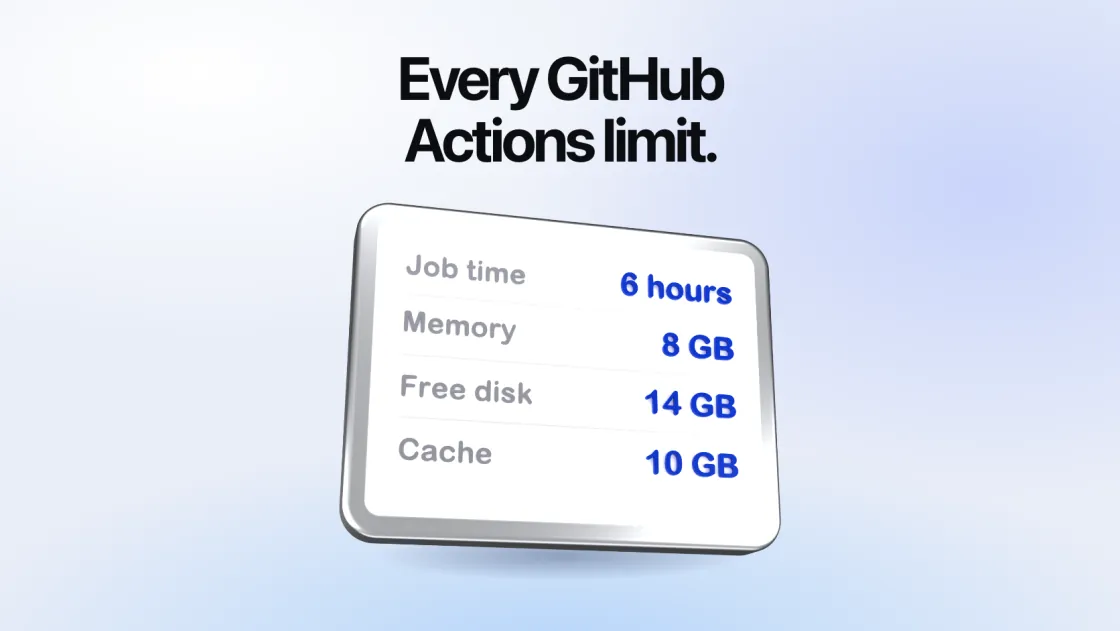
GitHub Actions has limits on how long a job runs, how much memory and disk it gets, how many jobs run at once, how much can be cached and stored, and how much you may spend. They are spread over a dozen pages of GitHub’s documentation. Here they are in one place, with which ones can be raised, and how.
Time
| Limit | How much | Can it change |
|---|---|---|
| A job on GitHub’s runners | 6 hours | No |
| A job on your own runners | 5 days | No |
timeout-minutes on a job, unless set | 360 minutes | Set it lower or, on your own runners, higher |
timeout-minutes on a step | 360 minutes at most | No |
| A whole workflow run | 35 days, waiting included | No |
| Waiting for an environment’s approval | 30 days | No |
| A job queued for your own runner | 24 hours, then cancelled | No |
GITHUB_TOKEN | 6 hours on GitHub’s runners, 24 hours on your own | No |
From GitHub’s limits, workflow syntax and GITHUB_TOKEN pages. More: GitHub Actions time limit: how to run jobs past 6 hours.
Memory, CPUs and disk
| Runner | CPUs | Memory | Disk |
|---|---|---|---|
| Standard, private repository | 2 | 8 GB | about 14 GB free of 75 GB |
| Standard, public repository | 4 | 16 GB | about 90 GB free of 150 GB |
| Larger runner | 2 to 96 | about 4 GB for each core, up to 384 GB | 75 GB on 2 cores, 150 GB on 4, up to 2,040 GB |
| macOS on Apple M1 | 3 | 7 GB | 14 GB |
GitHub’s runner reference promises 14 GB of disk; the free space figures are from a maintainer of the runner images. Memory and disk come with the runner: to have more, choose a bigger one. More: GitHub Actions out of memory and No space left on device in GitHub Actions.
Jobs at once
On GitHub’s standard runners:
| Plan | Jobs at once | macOS jobs at once |
|---|---|---|
| Free | 20 | 5 |
| Pro | 40 | 5 |
| Team | 60 | 5 |
| Enterprise | 500 | 50 |
Larger runners allow up to 1,000 jobs at once on Team and Enterprise, set per runner, and 100 GPU jobs. GitHub Support can raise these limits. Jobs over the limit wait: Waiting for a runner to pick up this job has that and the other reasons a job waits.
Other limits on what runs:
- A matrix makes at most 256 jobs in a run.
- A run can be re-run at most 50 times.
- A concurrency group queues at most 100 runs with
queue: max. - A repository can trigger at most 1,500 events every 10 seconds, and at most 500 workflow runs can be queued every 10 seconds.
- A workflow file must be 500 KB or smaller to start runs.
Cache and storage
| Limit | How much |
|---|---|
| Cache, each repository | 10 GB unless raised; GitHub charges for the rest |
| A cache entry not used | removed after 7 days |
| Cache uploads, each repository | 200 a minute |
| Cache downloads, each repository | 1,500 a minute |
| Artifact storage | 500 MB (Free), 1 GB (Pro), 2 GB (Team), 50 GB (Enterprise Cloud), shared with GitHub Packages |
The cache can be raised in the repository’s or organization’s Actions settings, up to 10 TB for a repository of a personal account, and what is over 10 GB is billed. When a repository is over its limit, GitHub evicts the oldest entries, which can lead to “cache thrashing” (dependency caching reference). GitHub Support “cannot increase storage limits” for artifacts.
API
The GITHUB_TOKEN may make 1,000 REST requests an hour for each repository, 15,000 on Enterprise Cloud (rate limits). A workflow that calls the API in a loop, or many workflows in one repository, can run into it.
Spending
Each plan includes Actions usage every month, in dollars: $12 on Free, $18 on Pro and Team, $300 on Enterprise Cloud (Actions billing). On the standard Linux runner, at $0.006 a minute, that is 2,000, 3,000 and 50,000 minutes. Standard runners in public repositories and self-hosted runners do not use it.
After that, use is billed, or stopped: without a payment method, or by a budget set to stop usage. A stopped job says “The job was not started because an Actions budget is preventing further use”. That post has how to find the budget and start jobs again, and What a GitHub Actions minute costs has every runner’s price.
Which limits your own runners lift
Jobs on your own runners keep GitHub’s limits on workflows: the matrix, re-runs, events, the API and the 35 days. What changes:
- Time: 5 days a job instead of 6 hours, with
timeout-minutesand the token’s 24 hours in mind. - Memory, CPUs and disk: whatever the machine has.
- Jobs at once: your own capacity, not your plan’s.
- Spending: GitHub does not charge for them, so no Actions budget stops them.
With SuperCI
SuperCI, which we make, gives those to every job without a fleet to look after: each job gets a fresh machine in your own AWS, Cloudflare or Modal account, of the size its label asks for, and the machine ends with the job.
jobs:
  build:
    runs-on: superci/cpu=16/ram=64/disk=200
    timeout-minutes: 720 # with the longest job raised under Settings → Limits
Its cache keeps 25 GB for each repository unless you set more, in your own account. Labels and machines has every size a label can ask for, and Order and limits the limits SuperCI adds: jobs at once and a monthly budget for each cloud.