actions/checkout v7: what changed since v4
v7 refuses fork pull request code in pull_request_target workflows, and so do v4, v5 and v6 since July. Here is every change since v4, the error, and the fixes.
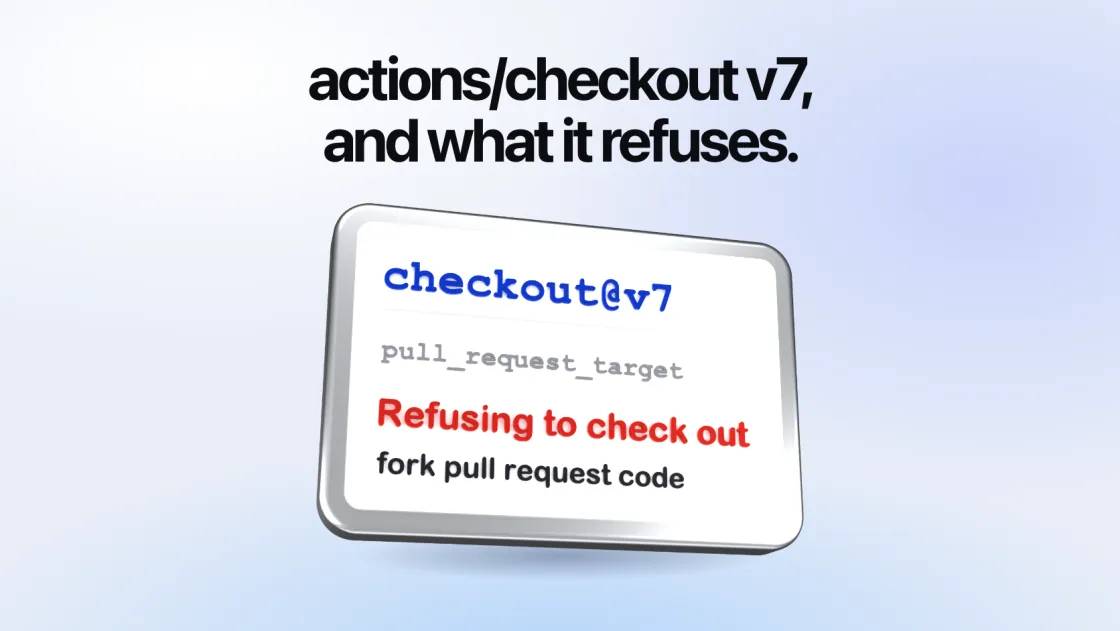
actions/checkout v7 came out on 18 June 2026. Most workflows can move to it by changing the number. The one change that breaks workflows reached the older versions as well: since 20 July 2026, @v4, @v5 and @v6 refuse to check out a fork’s pull request in a pull_request_target or workflow_run workflow, and fail with “Refusing to check out fork pull request code”. Here is what changed in each version since v4, what that error means, and what to do about it before GitHub’s next step on 2 December.
What changed, version by version
From the README and the releases:
| Version | Released | What changed | What it needs |
|---|---|---|---|
| v4 | 17 October 2023 | Runs on Node.js 20 | |
| v5 | 11 August 2025 | Runs on Node.js 24 | Runner 2.327.1 or newer |
| v6 | 20 November 2025 | The token is kept in a file under $RUNNER_TEMP, not in .git/config; git push and git fetch still work | Runner 2.329.0 or newer, for authenticated git inside Docker container actions |
| v7 | 18 June 2026 | Refuses fork pull request code in pull_request_target and workflow_run workflows; rebuilt as an ES module |
On GitHub’s own runners the runner is always new enough. On your own runners, the versions matter: a runner older than 2.327.1 cannot run v5 or later.
The refusal, also in v4, v5 and v6
From v7 on, a checkout step fails when the workflow was started by pull_request_target, or by workflow_run after a pull_request event, the pull request comes from a fork, and the step asks for its code:
ref: ${{ github.event.pull_request.head.sha }}ref: refs/pull/${{ github.event.pull_request.number }}/mergerepository: ${{ github.event.pull_request.head.repo.full_name }}
The step fails with:
Refusing to check out fork pull request code from a 'pull_request_target' workflow. This workflow runs with the base repository's GITHUB_TOKEN, secrets, default-branch cache scope, and runner access. Fetching and executing a fork's code in that trusted context commonly leads to "pwn request" vulnerabilities. To opt in, review the risks at https://gh.io/securely-using-pull_request_target and set 'allow-unsafe-pr-checkout: true' on the actions/checkout step.GitHub backported it on 20 July 2026, as v6.1.0, v5.1.0, v4.4.0, v3.7.0 and v2.8.0. A workflow that says @v4 got it that day without a change. One pinned to a full commit SHA or an exact version such as @v4.2.2 did not, and gets it when it is next updated. v1 was left as it was.
Pull requests from branches of the same repository are not affected, and neither is the pull_request event.
Why: pwn requests
pull_request_target runs with the base repository’s GITHUB_TOKEN and secrets, which is safe as long as it runs the base repository’s own code. Checking out the fork’s code and then running it (a make test, an npm install with its install scripts) hands those secrets to whoever opened the pull request. GitHub’s guide, Securely using pull_request_target, calls this a “pwn request” and “the root cause of multiple supply-chain compromises”.
What to do
1. Use pull_request if the job needs no secrets. It runs on the same events, runs the pull request’s code, and gives forks a read-only token and no secrets. Most CI belongs here; pull_request_target is often there only because someone once needed a secret.
2. Split the work if it does need secrets. Run the fork’s code under pull_request, with no secrets, and save what it produces as an artifact. A second workflow, on workflow_run, runs with secrets and reads that artifact as data, without checking out or running anything from the fork:
name: test  # .github/workflows/test.yml: the fork's code, no secrets
on: pull_request
jobs:
  test:
    runs-on: ubuntu-latest
    steps:
      - uses: actions/checkout@v7
      - run: npm ci && npm test -- --coverage
      - uses: actions/upload-artifact@v7
        with:
          name: coverage
path: coverage/coverage-summary.jsonname: report # .github/workflows/report.yml: secrets, no fork code
on:
workflow_run:
workflows: [test]
types: [completed]
jobs:
report:
runs-on: ubuntu-latest
permissions:
actions: read
pull-requests: write
steps:
- uses: actions/download-artifact@v8
with:
name: coverage
run-id: ${{ github.event.workflow_run.id }}
github-token: ${{ github.token }}
- run: node -e "console.log(require('./coverage-summary.json').total.lines.pct)"GitHub’s guide warns that a workflow_run workflow “should treat artifacts uploaded by other workflows as untrusted”: read them, never run them.
3. Opt in, if the code is never run. Some workflows check out a fork’s code only to read it, to label a pull request by the files it changes, say. After reviewing that, allow-unsafe-pr-checkout: true on the step lets it through:
- uses: actions/checkout@v7
  with:
    ref: ${{ github.event.pull_request.head.sha }}
    allow-unsafe-pr-checkout: true
The protection covers actions/checkout only. A git fetch, a gh pr checkout or a downloaded artifact that is then run is just as dangerous, and nothing stops it.
Next: pull_request_target blocked in public repositories
A second change follows on 2 December 2026. GitHub has added a default policy to public repositories that blocks workflows started by pull_request_target altogether. It runs in “evaluate” mode now, so runs continue and the policy’s insights show which would be stopped; from 2 December, GitHub’s guide says, it is enforced for affected repositories. It does not apply to private or internal repositories.
A public repository that still needs pull_request_target, for labeling or for comments on pull requests from forks, has to allow it in an Actions event policy before then. One that does not need it can move those workflows to pull_request now.
Which version to pin
@v7 gets fixes as they are released, as @v4 got the backport. Pinning a full commit SHA, kept current by Dependabot, guards against a tag being moved; like an exact version, it kept the July change out until the pin was updated. Either way, read the release notes before a major version.
With SuperCI
GitHub’s guide asks that a runner that may run untrusted code be “isolated and ephemeral”, and not reused across runs. SuperCI, which we make, runs GitHub Actions jobs on fresh machines in your own AWS, Cloudflare or Modal account, one for each job, and ends the machine with the job: nothing one pull request’s code leaves behind reaches the next job. How it works has the rest.
Related: GitHub Actions concurrency groups, and the GitHub Actions cache, whose writes from pull_request_target are read-only for the same reason.